
For much of the twentieth century, South Asia was associated with large families and rapid population growth.
That picture has changed.
Across much of the region, women are having far fewer children than their mothers and grandmothers did. In several countries, fertility has fallen to around or below the replacement level of roughly 2.1 births per woman.
Yet South Asia's population is still growing.
That apparent contradiction is at the heart of the region's demographic transition.
Falling fertility does not immediately produce a smaller population. Instead, it gradually changes the age structure, slows future population growth and eventually reshapes the size and composition of the population itself.
And South Asia is moving through that process at very different speeds.
What is the fertility rate?
The total fertility rate, or TFR, is the average number of children a woman would have over her lifetime if current age-specific fertility rates remained constant.
It is one of the most important indicators demographers use to understand population change.
A commonly used benchmark is 2.1 births per woman, often described as the approximate replacement-level fertility in populations with relatively low mortality.
If fertility remains around replacement level over the long term, a population can eventually stabilize, assuming migration and mortality do not significantly alter the picture.
If fertility remains substantially below replacement level, population ageing and eventual population decline become increasingly likely.
But the word eventually is crucial.
Demography moves slowly.
South Asia's fertility decline has been dramatic
The scale of the transformation becomes clearer when we look backward.
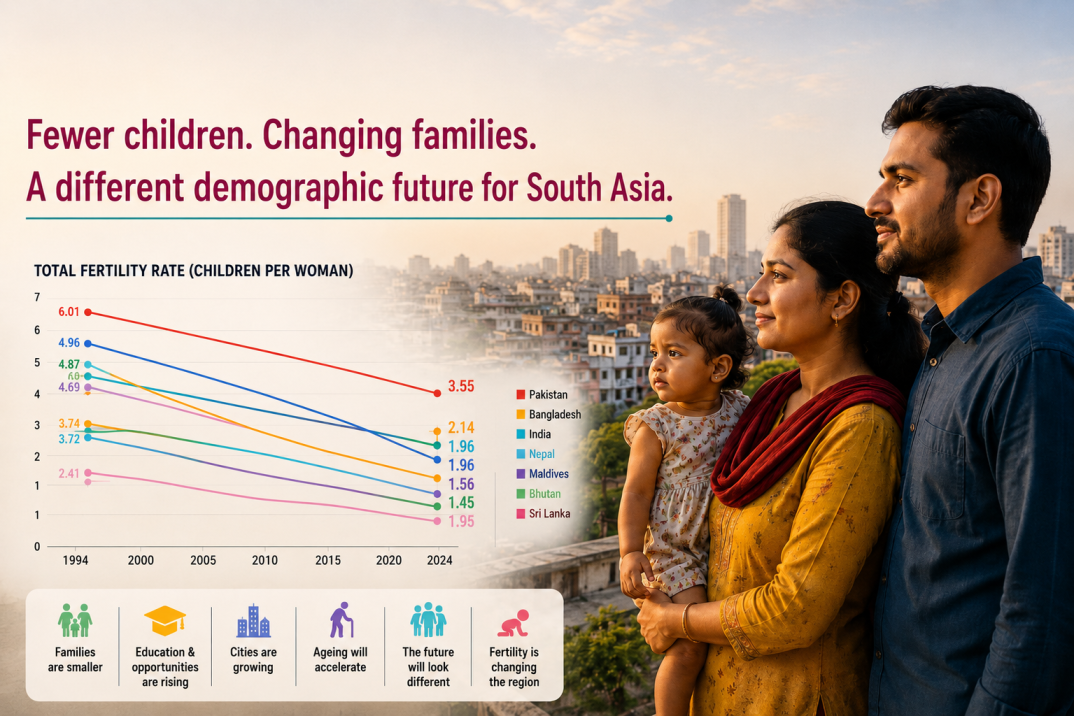
According to the United Nations' World Fertility 2024, several South Asian countries experienced very large declines in fertility between 1994 and 2024.
India's total fertility rate fell from about 3.72 births per woman in 1994 to 1.96 in 2024.
Nepal's fell from 4.96 to 1.96 over the same period.
Sri Lanka declined from 2.41 to 1.95.
Bangladesh fell from 3.74 to 2.14.
Bhutan experienced an even larger transition, from 4.87 to 1.45.
Maldives declined from 4.69 to 1.56.
These are not small changes. They represent a fundamental transformation in family size across the region.
Pakistan is an important contrast.
Its fertility rate was about 3.55 births per woman in 2024, substantially higher than India's, Bangladesh's, Nepal's or Sri Lanka's. The UN's World Fertility 2024 places Pakistan on a much slower path toward replacement-level fertility than several of its neighbours.
That difference matters enormously for the region's future.
One South Asia, very different fertility stories
It is tempting to talk about “South Asian fertility” as though the region has one number.
It doesn't.
Consider the contrast in the UN's 2024 estimates:
| Country | Fertility, 1994 | Fertility, 2024 |
| India | 3.72 | 1.96 |
| Bangladesh | 3.74 | 2.14 |
| Nepal | 4.96 | 1.96 |
| Sri Lanka | 2.41 | 1.95 |
| Bhutan | 4.87 | 1.45 |
| Maldives | 4.69 | 1.56 |
| Pakistan | 6.01 | 3.55 |
Source: UN DESA, World Fertility 2024.
The table tells a powerful story.
In 1994, high fertility was common across much of South Asia.
Thirty years later, several countries are below replacement level.
Pakistan remains the major exception among the larger South Asian populations.
This divergence will shape the region's demographic map for decades.
Why did fertility fall so quickly?
There is no single explanation.
South Asia's fertility transition is the result of several changes occurring together.
Education has expanded, particularly for girls and women.
Child survival has improved, reducing the need for very large families as a form of insurance against child mortality.
Access to contraception has increased.
Marriage and childbearing patterns have changed.
Urbanization has altered the economics and social organization of family life.
Parents increasingly invest more resources in each child, particularly in education.
And aspirations have changed.
For many families, having fewer children can make it possible to spend more on each child's education, health and future opportunities.
Economic development therefore matters, but fertility decline is not simply a consequence of becoming richer.
Social norms, women's autonomy, reproductive health services and access to information all matter.
But low fertility does not necessarily mean people want fewer children
This is where the contemporary fertility debate becomes more interesting.
The UNFPA's State of World Population 2025 argues that the central fertility problem in many countries is not simply that fertility is too high or too low.
It is that many people are unable to achieve the family size they actually want.
The report describes this as a problem of reproductive agency.
People may postpone having children because housing is expensive.
They may worry about job security.
They may struggle to balance employment and parenthood.
They may lack access to affordable childcare.
They may face unequal expectations around caregiving.
Or they may simply feel uncertain about the future.
UNFPA's 2025 report found that one in five adults surveyed globally expected not to have the number of children they wanted. Its analysis included countries with both relatively high and relatively low fertility.
This distinction is important.
A declining fertility rate does not automatically mean that people have suddenly decided they do not want children.
Sometimes it means that the conditions surrounding family formation have changed.
India's fertility transition shows why averages can hide complexity
India is an especially important case because of the country's enormous population.
The UN estimates India's fertility at about 1.96 births per woman in 2024.
But a national average hides substantial differences between states and regions.
Some parts of India have fertility levels well below replacement.
Other areas remain considerably higher.
This means India's demographic transition is occurring at different speeds within the same country.
The consequences will also differ.
States with very low fertility are likely to confront ageing earlier.
States with larger young populations will continue to have substantial numbers of people entering working ages.
For policymakers, one national fertility rate therefore tells only part of the story.
Bangladesh is close to the replacement threshold
Bangladesh provides another important example.
Its fertility fell from about 3.74 births per woman in 1994 to 2.14 in 2024, according to the UN. The country's fertility is therefore very close to the conventional replacement benchmark of 2.1.
But Bangladesh's population does not suddenly stop growing when fertility reaches replacement level.
The country has a large population base and a relatively young age structure.
Population momentum therefore continues to matter.
This is one reason fertility and population growth should never be treated as interchangeable indicators.
A country can have fertility close to replacement while still adding millions of people.
Nepal shows the power of fertility plus migration
Nepal's fertility transition has been particularly striking.
The UN estimates that fertility fell from about 4.96 births per woman in 1994 to 1.96 in 2024.
That places Nepal below the replacement benchmark.
But fertility is only one part of Nepal's demographic story.
International migration has become a major influence on the country's population structure and labour force.
Large numbers of working-age Nepalis live and work abroad, while remittances play an important role in the national economy.
This means Nepal's future population cannot be understood through fertility alone.
It requires looking simultaneously at:
births + deaths + migration + age structure.
That broader demographic framework will become important in the later articles in this cluster.
Sri Lanka is further along the transition
Sri Lanka entered the fertility transition earlier than many of its South Asian neighbours.
The UN estimates fertility at 1.95 births per woman in 2024, compared with 2.41 in 1994.
The country's experience illustrates what happens when low fertility combines with longer life expectancy and a relatively mature demographic transition.
The question gradually shifts.
It is no longer:
How do we slow population growth?
It becomes:
How do we support a population that is becoming older?
That means thinking about healthcare, pensions, caregiving, labour-force participation and the economic role of older adults.
Pakistan is on a different path
Pakistan stands out in the regional comparison.
The UN estimates its fertility at 3.55 births per woman in 2024, down substantially from 6.01 in 1994, but still well above replacement level.
This means Pakistan is likely to continue experiencing stronger population growth than several of its neighbours.
It also means that Pakistan will continue to have a large flow of young people entering working ages.
That can be an enormous opportunity.
But again, the demographic dividend is not automatic.
A large youth population becomes an economic advantage only when countries can provide education, health, skills and productive employment.
Pakistan's demographic trajectory therefore creates both opportunity and pressure.
Why does population keep growing after fertility falls?
This is the question many readers ask.
The answer is population momentum.
Imagine a country where fertility falls rapidly.
There may still be millions of young adults entering reproductive ages because of the country's demographic history.
Even if each of them has fewer children, the total number of births can remain substantial.
As a result, population growth can continue for years or even decades after fertility falls below replacement.
This is why a fertility rate of around 2.0 does not mean a country's population will immediately shrink.
The age structure has to change first.
Eventually, as smaller generations replace larger ones, population growth slows further.
Only later may population decline become visible.
Falling fertility changes the age pyramid
The long-term effect of lower fertility is not simply fewer babies.
It changes the entire population structure.
When fertility is high, populations tend to have a broad base: many children and relatively fewer older people.
As fertility declines, the base becomes narrower.
The working-age population initially becomes relatively large.
Later, the older population grows as those large working-age cohorts age.
This creates a demographic sequence:
High fertility → declining fertility → large working-age population → population ageing → possible population decline.
South Asian countries are currently at different points along this sequence.
That is why their policy priorities will increasingly diverge.
The demographic dividend has a deadline
Lower fertility can create a temporary economic opportunity.
When the share of working-age people rises relative to children and older people, countries may have a larger potential labour force and fewer dependants per worker.
This is the demographic dividend.
But it is a window, not a permanent condition.
If countries fail to create jobs, improve education, increase productivity and enable women to participate fully in the economy, the opportunity can be lost.
And once the population begins ageing, the policy challenge changes again.
The same generation that creates a large working-age population today eventually becomes the older population of tomorrow.
That is why fertility policy cannot be separated from labour-market policy.
What happens next?
The next phase of South Asia's demographic transition will be defined less by rapid fertility decline alone and more by the consequences of that decline.
Countries will increasingly have to manage:
Slower population growth.
Changing school-age populations.
Large working-age cohorts.
Migration.
Urbanization.
Population ageing.
Healthcare and social protection.
And perhaps most importantly, the changing relationship between family size and economic opportunity.
The UN's World Fertility 2024 projects further fertility decline across the region. For example, India's fertility is projected at about 1.75 births per woman in 2054, while Bangladesh is projected at 1.79 and Nepal at 1.72. Pakistan is projected to remain higher, at around 2.50 in 2054.
These projections should not be interpreted as certainties.
They are scenarios based on demographic assumptions.
But they illustrate the direction of travel: South Asia is moving toward smaller families, while the speed of that movement differs sharply between countries.
The surprising part: fertility decline is not necessarily a crisis
Low fertility is increasingly described as a demographic crisis.
Sometimes it is.
Very low fertility combined with rapid ageing can create serious challenges for labour markets, pensions and healthcare systems.
But treating fertility only as a number creates another problem.
If governments respond simply by trying to increase the birth rate, they may miss the reasons people are having fewer children than they would otherwise like.
The UNFPA's 2025 findings suggest a different starting point:
Ask people what family size they want—and then examine what prevents them from achieving it.
That could mean better childcare.
More flexible work.
Affordable housing.
Improved reproductive healthcare.
Greater gender equality.
More predictable employment.
And policies that make it easier—not compulsory—for people to form the families they want.
South Asia's fertility story is really a story about choices
The decline in fertility is one of the most consequential changes in South Asia's modern history.
But the number itself is only the beginning.
India, Bangladesh, Nepal, Sri Lanka, Bhutan, Maldives and Pakistan are moving through different demographic transitions.
Some are already below replacement fertility.
Some are close to it.
Others remain considerably above it.
Their populations will therefore continue to evolve differently.
The important question is not simply whether fertility is falling.
It is what happens after fertility falls.
Will countries convert large working-age populations into productive employment?
Will women be able to participate fully in economic life?
Will cities adapt?
Will healthcare and social-protection systems prepare for ageing?
And will people who want children have the economic and social conditions needed to have them?
South Asia's fertility transition is not the end of the population story.
It is the beginning of a different one.
Key Takeaways
- Fertility has fallen dramatically across much of South Asia.
- India, Nepal and Sri Lanka are already below the conventional replacement benchmark of 2.1 births per woman.
- Bangladesh is very close to replacement level.
- Pakistan remains significantly above replacement fertility.
- Falling fertility does not immediately cause population decline because of population momentum.
- Lower fertility changes the age structure and eventually contributes to population ageing.
- A large working-age population can create a demographic dividend, but only if economies generate productive opportunities.
- Fertility rates do not necessarily reflect people's desired family size.
- UNFPA's 2025 analysis emphasizes reproductive agency and the barriers that prevent people from achieving their desired family size.
- South Asia's fertility transition is therefore both a demographic story and a story about family choices, economic conditions and social policy.
Data Sources
The primary demographic source for the country-level fertility comparisons in this article is the United Nations Department of Economic and Social Affairs, World Fertility 2024.
Long-term population estimates and projections are based on the United Nations World Population Prospects 2024, the UN's official population estimates and projections dataset covering 237 countries and areas and extending projections to 2100.
The article's discussion of reproductive aspirations and barriers draws on UNFPA's State of World Population 2025: The Real Fertility Crisis — The Pursuit of Reproductive Agency in a Changing World.
Related Articles in Cluster #1
South Asia's Population Is Changing Faster Than You Think
South Asia Is Still Young. But for How Long?
When Will South Asia's Population Stop Growing?
Why Are Some South Asian Countries Growing While Others Are Ageing?
What South Asia's Changing Population Means for Jobs, Migration and Cities