
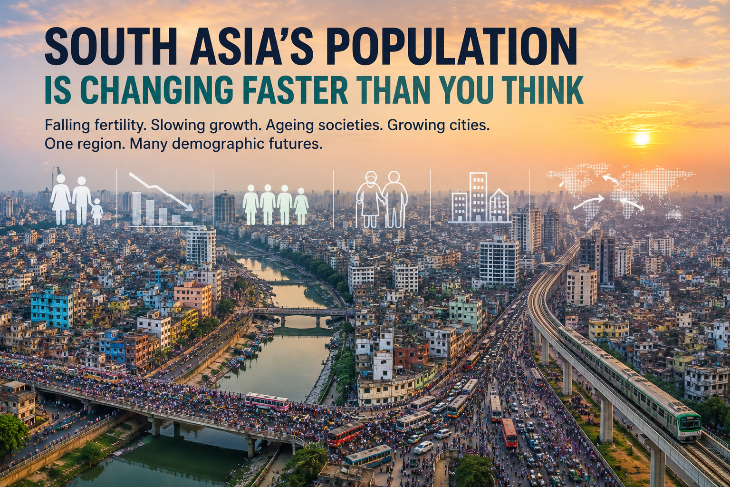
For as long as most of us have been alive, the story of South Asia’s population has had one plot: too many people, too fast. It’s the image most outsiders still carry crowded trains, overflowing cities, endless queues.
That story isn’t wrong, exactly. It’s just no longer complete.
Fertility is falling. Growth is slowing — unevenly, but unmistakably. Millions of young people are ageing into the workforce right now, this decade, not in some hypothetical future. Migration is quietly reshaping who lives where. And in a shift that would have seemed almost unthinkable a generation ago, population ageing is becoming a real policy conversation in parts of the region.
South Asia isn’t living through one demographic story. It’s living through five or six of them at once, unfolding at different speeds across India, Bangladesh, Pakistan, Nepal, and Sri Lanka. Understanding that divergence matters more than knowing the raw headcount.
South Asia is still a population giant
Start with scale, because it’s genuinely hard to picture. The World Bank’s South Asia aggregate — Bangladesh, Bhutan, India, Maldives, Nepal, and Sri Lanka — put the region’s population at roughly 1.69 billion in 2025. India alone accounts for about 1.46 billion of that.
(Pakistan and Afghanistan sit geographically within South Asia too, though the World Bank tracks them separately in its regional groupings. Any full picture of the region has to include them.)
Numbers this large can hide what’s actually happening underneath them. A region can add tens of millions of people every year while its growth rate quietly falls — and that’s exactly the transition South Asia is in the middle of. So the interesting question isn’t really “is South Asia’s population growing?” It’s why it’s still growing, how fast that growth is slowing, and what the population will look like on the other side of the transition.
Fertility is rewriting the trajectory
Underneath almost everything else in this story is one long-running shift: women across South Asia are having fewer children than their mothers and grandmothers did.
The reasons stack on top of each other — more years of schooling, later marriage, wider access to contraception, lower child mortality (so families no longer need extra children as a safety net), urban living, and the simple rising cost of raising kids well. India is the clearest example: the World Bank’s latest data puts the country’s total fertility rate at about 2.0 births per woman in 2024, a steep drop from a generation ago.
But “South Asia” isn’t one fertility story. Bangladesh has been through its own dramatic transition. Nepal and Sri Lanka have pushed even further into low-fertility territory. Pakistan, by contrast, is still on a comparatively high-fertility path.
Why does this matter beyond the statistics? Because fertility today quietly writes the population structure a country inherits decades later. Fewer births now means fewer young people down the line, and fewer young people eventually means slower growth in the working-age population after that. The effects don’t show up immediately — they arrive on a lag, sometimes a generation long.
South Asia doesn’t have one demographic future
This might be the single most important idea in this whole piece: there’s no such thing as the South Asian demographic future. There are several, running in parallel.
India has an enormous population base, but growth there is slowing steadily. Bangladesh has pulled off a striking fertility transition despite being one of the most densely populated places on Earth. Pakistan is still growing quickly, with fertility well above its neighbors. Nepal’s story is shaped as much by large-scale migration abroad as by falling birth rates. And Sri Lanka has already moved deep into low-fertility, ageing-population territory — years ahead of most of the region.
It’s more useful to think of this as a South Asian demographic divide than a single regional trend. Some countries are still adding people quickly. Some are slowing down. A few are starting to face what population ageing actually looks like in practice. The region’s demographic map is getting more diverse, not less.
Why is the population still growing if fertility is falling?
This sounds like a contradiction, and it trips a lot of people up. The explanation is one of demography’s more elegant ideas: population momentum.
A country’s fertility rate can fall to a fairly low level while its total population keeps climbing for years, even decades, afterward. The reason is structural. If a country already has a huge number of young people, most of them are still going to pass through their reproductive years — and even if each of them has fewer children than their parents did, that many potential parents can still add up to a lot of births in absolute terms.
So demographic change doesn’t work like flipping a light switch. Fertility falls first. Population growth slows later. Ageing follows after that. And outright population decline, where it eventually happens, tends to arrive later still. A lot of what South Asia’s population looks like today is the delayed result of decisions and trends set in motion decades ago.
Still young — but the window won’t stay open
South Asia remains one of the youngest large regions on the planet, and in principle, that’s an enormous asset. When a big share of a country’s population moves into working age at once, economists call it a demographic dividend — more workers, relatively fewer dependents, more room for savings and growth.
But a dividend isn’t automatic. It has to be earned. Young people need real education, usable skills, decent health — and, most critically, enough productive work to actually absorb them.
That last piece is where the region is currently struggling. The World Bank’s latest assessment found that only about 59 percent of working-age people in South Asia are employed, with female labor-force participation lagging particularly far behind. Add in the widespread informality of South Asian labor markets — jobs without contracts, benefits, or security — and it’s clear the region has more young people than it currently has good jobs for.
The youth opportunity has a deadline
That gap matters because demographic windows don’t stay open indefinitely. The World Bank estimated in 2025 that South Asia’s population aged 15 to 24 could approach 300 million by 2035. Under a business-as-usual scenario, it warned that more than 70 million of those young people could end up out of school and out of work at the same time.
That’s not a distant, 2050-level problem — it’s a live policy question for the next ten years. It touches whether education systems can prepare students for a fast-changing labor market, whether economies can create jobs quickly enough, whether women get real access to paid work, whether cities can build the infrastructure a younger, more urban population needs, and whether governments start preparing now for populations that will eventually skew older. The demographic dividend, in other words, is a race against a clock that’s already running.
Migration is redrawing the map
Births and deaths only tell part of the population story. Migration is the other half.
People from South Asia have long moved for work, study, family, and opportunity — to the Gulf states, Europe, North America, Australia, and other parts of Asia. And migration doesn’t just move individuals; it reshapes the demographic structure of the places they leave and the places they arrive.
When a large share of working-age adults leaves a community, the people who remain tend to skew older. Some rural areas lose their young adults almost entirely. Some households come to depend on the money sent home. Some cities — and some destination countries — end up with an outsized share of working-age migrants. Migration redistributes labor and income, yes, but it also redistributes age itself.
Nepal is a particularly clear case of this, and it deserves a much deeper look than a few paragraphs can offer — which is exactly why migration gets its own article in this series.
Urbanization is its own demographic shift
People aren’t spread across South Asia the way they were a generation ago. Urban populations are expanding, and the World Bank’s urban population data — now running through 2025 — reflects a steady, ongoing shift toward city living.
But “urbanization” undersells what’s actually happening. It isn’t just villagers moving into officially designated cities. Metro regions are sprawling outward. Smaller, secondary cities are growing fast. Informal settlements are expanding at the edges. Rural and urban economies are getting harder to tell apart.
That changes what population growth actually demands in practice. A growing population needs more schools and clinics. A growing urban population needs all of that, plus housing, transit, water, sanitation, waste systems, energy, and infrastructure that can hold up under pressure. Population policy and urban policy, increasingly, are the same conversation.
2025–2026: the jobs problem is getting more urgent
All of this is unfolding against a shifting economic backdrop. The World Bank’s April 2026 South Asia Economic Update projects regional growth slowing to 6.3 percent in 2026, down from 7 percent in 2025 — alongside a clear call for reforms that can generate more jobs.
That’s a demographic story as much as an economic one. A young population is only an asset if people can actually find productive work, and the World Bank flags real headwinds: pressure from AI-exposed industries and persistent mismatches between local labor markets and the jobs that actually exist.
Put simply: South Asia’s demographic transition and its employment challenge aren’t two separate stories. They’re one story. The region isn’t just figuring out how to accommodate more people — it’s figuring out how to create real opportunity for a population that’s changing shape underneath it.
What will South Asia look like by 2050?
The honest answer: it depends heavily on which country you’re asking about.
The UN’s World Population Prospects 2024 — the standard long-term reference for this kind of question — models population trends from the 1950s through today and projects forward to 2100 for 237 countries and territories, under a range of assumptions. No single number from that dataset is a guarantee; fertility, mortality, and migration can all shift the projections. What’s more reliable is the direction of travel.
South Asia, broadly, is heading toward slower population growth, smaller families, a changing balance between children and working-age adults, a gradually larger older population, continued urban growth, and — running through all of it — widening differences between countries. The South Asia of 2050 won’t just be a bigger version of today’s South Asia. It’ll be a genuinely different one.
Why this matters beyond South Asia
It’s tempting to file all of this under “regional news.” That would be a mistake. South Asia is home to a huge share of humanity, and an increasingly important share of the global workforce and consumer market — so its demographic shifts ripple outward.
They’ll shape global migration, as changing job markets at home push and pull people abroad. They’ll shape labor markets worldwide, since how well South Asia employs its young population affects global production and services. They’ll shape remittances, the lifeline connecting millions of migrant households to economies across the globe. They’ll shape cities, as South Asian metro regions grow into some of the largest urban markets — and biggest infrastructure challenges — on the planet. They’ll shape ageing policy, as the countries that reached low fertility earliest start needing healthcare, pension, and social-protection systems built for older populations. And they’ll shape global growth itself, simply because of the sheer size of the population involved.
For readers in Europe, North America, Australia, or anywhere else, South Asia’s demographic transition isn’t a distant regional footnote. It’s part of how the global population is changing, full stop.
The real story isn’t “how many”
For decades, the question everyone asked was simple: how many people will South Asia have? That question still matters. But on its own, it’s no longer enough.
The more interesting questions now are: How old will they be? Where will they live? How many children will families choose to have? Where will young people actually find work? How many people will migrate, and to where? Which countries keep growing, and which start shrinking? And — maybe the question that matters most — will governments and economies adapt fast enough to keep up with all of it?
South Asia is still growing. But the engine behind that growth is changing shape. Fertility is falling. Growth is slowing in several countries. An enormous cohort of young people is moving into working age right now. Migration is reshaping communities. Urbanization is reshaping where people live. And ageing is moving from a distant hypothetical to something governments actually have to plan for.
The biggest demographic story in South Asia was never really about the number of people. It’s about who those people are, where they live, how old they are, and what kind of opportunities are waiting for them. That transformation will shape South Asia’s future — and, increasingly, the world’s.
Key takeaways
- South Asia is still one of the largest population centers on Earth — but the story underneath that number is shifting fast.
- Growth is slowing, though population momentum means it won’t stop the moment fertility does.
- Fertility has fallen sharply across the region, but not at the same pace everywhere — India, Bangladesh, Nepal, and Sri Lanka are well ahead of Pakistan.
- The region’s huge youth population is a potential demographic dividend — but only if economies create enough real jobs to absorb it.
- Migration and urbanization are quietly redrawing where — and how old — South Asia’s population is.
- Ageing is becoming a live policy issue, not a distant one, as fertility stays low.
- South Asia’s demographic future is getting more diverse between countries, not more uniform.
- What happens here won’t stay here — the consequences reach well beyond the region.
Sources & data notes
Long-term estimates and projections draw on the UN’s World Population Prospects 2024. Current population, fertility, and urbanization figures are cross-checked against the World Bank’s World Development Indicators. Recent economic and employment context comes from the World Bank’s South Asia Economic Update, April 2026.
A note for future updates: historical estimates, current estimates, and projections are different kinds of data. Any figures updated later should keep their original reference year and source attached.
Coming next in this series
- South Asia’s Fertility Rate Has Fallen Below Replacement Level. What Happens Next?
- South Asia Is Still Young. But for How Long?
- When Will South Asia’s Population Stop Growing?
- Why Are Some South Asian Countries Growing While Others Are Ageing?
- What South Asia’s Changing Population Means for Jobs, Migration, and Cities